

Zero-Allocation Row Model
DataVo can scan entire tables without allocating a single managed object per row. RowRef is a readonly ref struct that wraps a ReadOnlySpan<byte> over a row's stored bytes, and RowRefStream yields RowRef values to a foreach loop in 1,024-row pages. Once a thread has warmed up on a table's layout, a full scan allocates 0 bytes on the managed heap.
using DataVo.Core;

RowRefStream players = db.Table<Player>().StreamRef();

// Resolve column ordinals once before the loop (ordinal lookup allocates once)
int scoreCol = players.GetOrdinal("Score");

long totalScore = 0;
foreach (RowRef row in players)
{
    if (!row.IsNull(scoreCol))
    {
        totalScore += row.GetInt32(scoreCol);
    }
}
The same zero-allocation stream is available without a model type via db.StreamRef("players").
How RowRef Works
Conventional database drivers materialize a dictionary, object[], or POCO for every row: 200,000 rows means 200,000 heap allocations that the GC must later collect. RowRef avoids materialization entirely by decoding only the cells you read directly from the storage buffer.
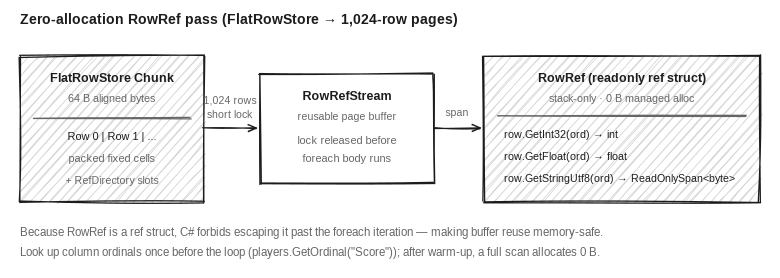
Because RowRef is a ref struct, the C# compiler enforces that it lives strictly on the stack: it cannot be boxed, stored on a class field, captured by a lambda, or held across an await. That compile-time guarantee makes it memory-safe for RowRefStream to reuse the same page buffer for the next 1,024 rows.
Rules & Safety Guarantees
- Iteration-scoped lifetime: A
RowRefis valid only inside theforeachiteration that produced it. Copy any value you need to retain past the loop body. - Span views follow the same lifetime:
GetStringSpanandGetStringUtf8return views directly into the row buffer; callnew string(span)or copy the bytes if you need the text later. - Strict typing with lossless widening: Accessors must match the column's declared type (with lossless widening:
INTviaGetInt64,FLOATviaGetDouble). Mismatched types throwInvalidCastException. - Explicit NULL checks: Reading a NULL cell throws
InvalidOperationException. Callrow.IsNull(ordinal)first on nullable columns. - Table column order: Ordinals follow
CREATE TABLEorder or the property declaration order on a[DataVoTable]model.
Concurrency & Page Isolation
- Non-blocking 1,024-row pages: The engine acquires a short read lock only while copying a 1,024-row page into the stream buffer, then releases it before your loop body executes, so slow consumers never stall writers.
- Pass semantics: Every row that exists for the entire pass is visited once; concurrent inserts or deletes may or may not appear. A concurrent schema change aborts the pass with
InvalidOperationException. - Inside explicit transactions:
StreamRef()falls back to the query engine so it observes the transaction's own uncommitted writes. That transactional path allocates.
What "Zero Allocation" Covers
Zero allocation applies specifically to RowRefStream scans and compiled scan-kernel aggregates; materializing a Player class instance still allocates the Player object itself.
| Operation | Managed Allocation |
|---|---|
Full RowRefStream pass (after thread warm-up) | 0 B |
Compiled LINQ Count/Sum/Min/Max over 200,000 rows | 0 B |
Compact InMemory PK lookup into Player (FlatRowStore) | 56 B (the Player object itself) |
Lsm PK lookup into Player | 144 B |
RowRefStream pass inside an explicit transaction | Allocates |
Nothing in RowRef or RowRefStream uses runtime reflection or System.Reflection.Emit; DataVo.Core compiles cleanly with IsAotCompatible and zero trim/AOT warnings.
See Also
- Streaming Queries: Comparing
Execute,StreamQuery, andStreamRef - Compiled Scan Kernels: Build-time LINQ kernels that run over stored bytes with 0 B allocation
- Native AOT Deployment: Publishing trimmed Native AOT binaries