

Introduction
DataVo is an embedded database engine written in C# for .NET 10. It runs directly inside your application process with no external server, no native DLLs, and full Native AOT compatibility, combining SQL, LSM storage, columnar indexes, vector search, and live reactive views in one library.
using DataVo.Core;
using DataVo.Core.StorageEngine.Config;

using var db = new DataVoContext(new DataVoConfig { StorageMode = StorageMode.InMemory });
db.Execute("CREATE DATABASE Demo");
db.Execute("USE Demo");
db.Execute("CREATE TABLE players (Id INT PRIMARY KEY, Name VARCHAR(80), Score INT)");
db.Execute("INSERT INTO players (Id, Name, Score) VALUES (1, 'Ada', 950)");

var result = db.Execute("SELECT Name, Score FROM players WHERE Id = 1")[0];
Console.WriteLine($"{result.Data[0]["Name"]}: {result.Data[0]["Score"]}");
Choose Your Path
[DataVoQuery] methods at build time with zero reflection.Live Z-Set Reactive ViewsMaintain SQL and LINQ views incrementally with pull-drain delta notifications.DataVo-SyncOffline-first bidirectional PostgreSQL synchronization (commercial add-on).Architecture Overview
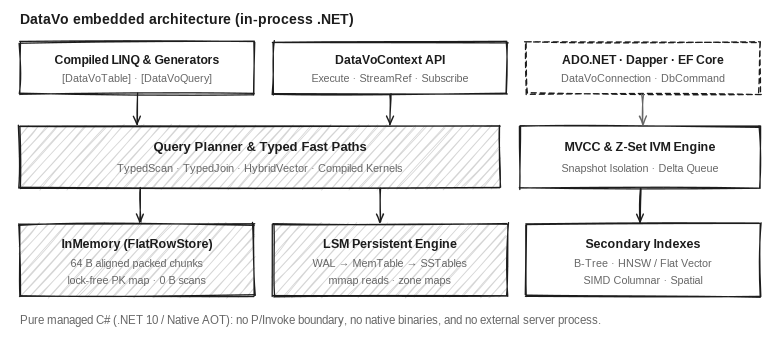
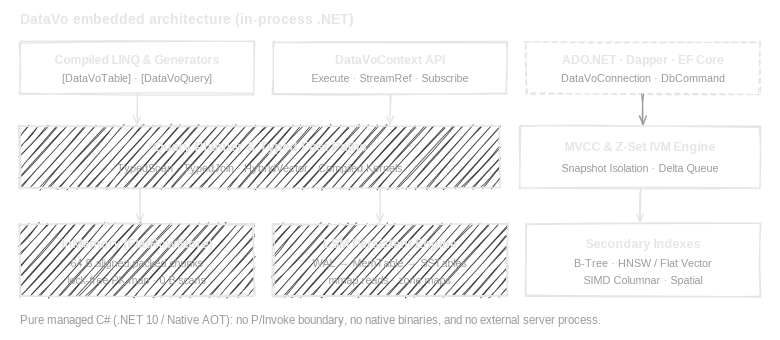
Every client interface—DataVoContext, compiled LINQ, ADO.NET, Dapper, and the EF Core bridge—routes into the same parser, typed query planner, and storage engines.
Storage Engines
| Mode | Backing Engine | Best For |
|---|---|---|
StorageMode.InMemory | Packed contiguous row buffers (FlatRowStore) | Ephemeral caches, tests, simulations, game state |
StorageMode.Lsm | Commit log (WAL), arena MemTables, memory-mapped SSTables, 4,096-row columnar segments | Production embedded persistence with LsmStrictFsync = true |
StorageMode.Disk | Legacy paged file engine | Reading existing v0.1/v0.2 data only; prefer Lsm for new work |
Typed Fast Paths & Vector Search
Queries are first offered to typed execution paths (single-table scans, integer-key hash joins, columnar aggregates, index-driven joins, and filtered vector search) that read cells straight from stored bytes without building per-row dictionaries. If a query shape is outside the fast paths, it falls back to the general evaluator with identical semantics.
VECTOR(n) columns are first-class relational columns backed by SIMD-accelerated FLAT (exact) or HNSW (approximate graph with cost-based exact fallback) indexes, keeping embeddings and metadata in one transaction log.
Packages at a Glance
| Package | Purpose | Native AOT |
|---|---|---|
DataVo.Core | Embedded engine, DataVoContext, storage engines, vector & reactive APIs | Yes |
DataVo.Generators | Roslyn source generator for [DataVoTable], [DataVoQuery], and compiled LINQ | Yes |
DataVo.Data | Standard ADO.NET provider (DataVoConnection, DataVoCommand, DataVoDataReader) + Dapper | Yes |
DataVo.EntityFrameworkCore | Experimental EF Core bridge (UseDataVo(...)); not a standalone provider | No |
Where DataVo Fits and Where It Doesn't
- Strong fit: Local-first
.NET 10apps, game tooling, simulations, and retrieval workloads that combine relational filtering with vector search. On warm caches, v0.4 outperforms SQLite on key lookups, low-cardinalityGROUP BY, integer-key joins, columnar aggregates, and filtered vector search. - Not a fit: Client/server deployments, multi-process writes to one directory (
datavo.lockenforces single-process ownership), stored procedures/triggers, or serializable predicate locking. For whole-table analytics over tens of millions of rows, DuckDB remains orders of magnitude faster. - Need multi-device PostgreSQL sync? DataVo-Sync is a separate commercial add-on providing offline-first bidirectional sync over WebSocket/HTTP with wire v2 + Brotli.
See Also
- Installation & Packages: NuGet packages (
0.4.0-rc.1) and.NET 10requirements. - Quickstart: End-to-end C# walkthrough with
InMemoryandLsm. - DataVo vs SQLite: Oracle-verified benchmarks across 28 SQL shapes and vector queries.
- Status & Roadmap: Release candidate guarantees, boundaries, and the v0.5 plan.