

Query Planner & Fast Paths
DataVo does not use a cost-based optimizer. Instead, it pairs one general evaluator that can execute every supported SQL query with a cascade of typed fast paths that operate directly on stored bytes without boxing. Whether a query stays on a typed path is the single largest factor in its latency and allocation profile.
using var db = new DataVoContext(new DataVoConfig { StorageMode = StorageMode.Lsm, DiskStoragePath = "./app_db" });

// Stays on the Typed Single-Table Path (index lookup or UTF-8 byte scan, ~16–24 KB alloc / 1M rows)
var stmt = db.Prepare("SELECT Id, Name, Score FROM players WHERE Region = @r AND Score >= @min");
var result = stmt.Execute(new DataVoQueryParameter("r", "EU"), new DataVoQueryParameter("min", 500));
Dispatch Cascade
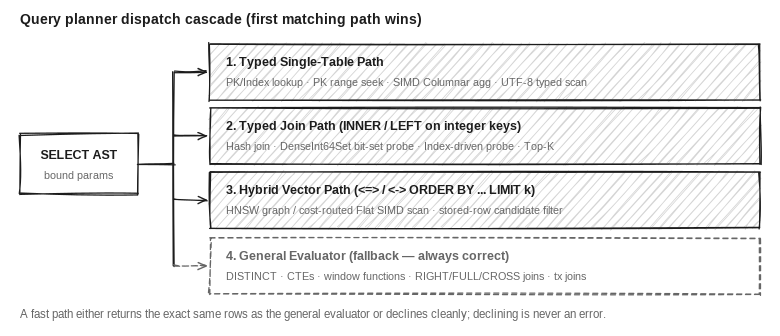
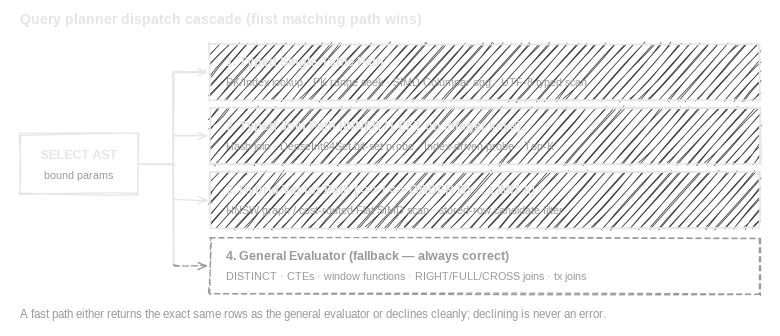
Every SELECT is offered to the fast paths in order. A fast path either returns the exact same rows as the general evaluator (in the same order) or declines cleanly; declining is never an error.
The general evaluator materializes every scanned row as a Dictionary<string, object?> (2–4 KB per row read), which turns a 1,000,000-row scan into gigabytes of GC pressure and multi-second latency. Moving OR, LIKE, and multi-table joins onto typed paths reduced those queries from 1.7–5.0 s down to 20–100 ms (DataVo vs SQLite).
1. Typed Single-Table Path
Accepts single-table queries whose WHERE clause combines AND, OR, NOT, column-vs-value comparisons (=, <>, <, <=, >, >=), IS [NOT] NULL, and LIKE / NOT LIKE, with any combination of aggregates, GROUP BY, HAVING, ORDER BY, LIMIT, and OFFSET.
| Access Method | When Selected | Mechanism |
|---|---|---|
| Index point lookup | Equality on PK or single-column B-tree index | Reads matching row keys in one index lookup, then fetches those rows by key. |
| Primary-key range seek | BETWEEN or >= / < on integer PK | On LSM, seeks SSTables and reads sequentially. On InMemory, binary-searches a lazily built sorted key copy (falls back to scan if range > 25% of table). |
| SIMD columnar aggregate | COUNT/SUM/AVG/MIN/MAX without GROUP BY on [Columnar] numeric columns | Reads 4,096-row columnar chunks with SIMD kernels; LSM skips chunks via min/max/NULL/NaN zone maps. |
Index-driven GROUP BY | Whole-table GROUP BY on one indexed integer key with COUNT(*) / COUNT(key) | Streams finished groups in key order from the index without building a hash table. |
| Full typed scan | All other accepted predicates | Decodes only referenced columns in storage order; evaluates WHERE before materializing matches. |
Key implementation details:
- Zero-allocation UTF-8 text matching: On LSM,
=,<>,LIKE,NOT LIKE,IS [NOT] NULL, and single-column textGROUP BYcompare stored UTF-8 bytes directly without allocating.NETstrings (falling back to UTF-16 decode only for_wildcards against non-ASCII text). - Bounded top-k sorting:
ORDER BY ... LIMIT kwithout a usable index compares sort-key cells in place against a bounded list ofkwinners, copying keys only when a row enters the topk. - Floating-point determinism on LSM:
SUMandAVGoverFLOAT/DOUBLEcolumns are intentionally routed to the row scan when an LSM columnar index has an unflushed tail, guaranteeing bit-for-bit identical floating-point addition order. Integer sums,COUNT,MIN, andMAXare always pushed.
2. Typed Join Path
Accepts INNER and LEFT joins of any number of tables on integer equality keys, including per-table WHERE predicates (OR, LIKE), aggregates with or without GROUP BY, and top-N projections.
- Hash join: Streams the largest table (for all-
INNERjoins) or theFROMtable (when aLEFT JOINmust preserve unmatched rows). Other tables are hashed on their join key, keeping only post-join columns.INNERfilters apply during build;LEFTfilters evaluate after NULL padding. - Key-only bit sets (
DenseInt64Set): When a joined table contributes only its key (such asLEFT JOIN ... WHERE c.Id IS NULLor existence checks) and keys are distinct and dense (≤ 64 span per key), DataVo packs them into a compact bit set (12.5 KB for 100,000 keys instead of a 2.9 MB hash table). - Index-driven probe: For all-
INNERjoins where the hashed side is selective, a 32-key sample estimates fan-out; if ≤ 12.5% of the streamed table matches, DataVo probes via its single-column index in key order.
3. Hybrid Vector & General Fallback
- Hybrid Vector Path: Handles
ORDER BY embedding <=> @q LIMIT k(and<->) with optionalWHEREfilters and joins. Over-fetches candidates byLIMIT / selectivity, evaluates typed predicates directly on stored candidate rows, and cost-routes HNSW searches to an exact SIMD Flat scan whenever the widened beam exceeds the graph crossover threshold. See Vector Search. - General Evaluator: Executes
SELECT DISTINCT, CTEs, computed select-list expressions, window functions (RANK() OVER (...)),RIGHT/FULL/CROSSjoins, text/GUID joins, cross-tableORpredicates, and joins inside explicit transactions. Single-table reads inside an explicit transaction remain on the typed scan over the MVCC snapshot.
Compiled Queries & Planner Limits
Source-generated [DataVoQuery] methods and intercepted DataVoTable<T> LINQ queries bypass SQL parsing entirely and compile directly to typed byte-reading kernels (see Compiled Scan Kernels).
What the planner does not do:
- It does not keep persistent table statistics (index-probe decisions sample keys at runtime).
- It does not reorder arbitrary multi-way joins beyond selecting the streamed table and index probes.
- It does not use secondary indexes to satisfy
ORDER BYor non-countingGROUP BYshapes.
See Also
- Zero-Allocation Row Model: Stack-only
RowRefscans over stored bytes - Compiled Scan Kernels: How Roslyn interceptors compile LINQ predicates into storage loops
- DataVo vs SQLite: Measured latency across 28 SQL shapes and 5 hybrid vector queries