

Streaming Queries
By default, db.Execute("SELECT ...") buffers the entire result set into List<Dictionary<string, object?>> before returning. When scanning large tables or stopping early on a match, use DataVo's pull-based streaming APIs to process rows incrementally in 1,024-row pages, or with zero heap allocations.
using DataVo.Core;
using DataVo.Core.StorageEngine.Config;

using var db = new DataVoContext(new DataVoConfig { StorageMode = StorageMode.InMemory });
db.Execute("CREATE DATABASE Game; USE Game;");
db.Execute("CREATE TABLE players (id INT PRIMARY KEY, name VARCHAR, score INT)");

// Lazily fetches 1,024-row pages; stops scanning storage immediately on break
foreach (DataVoRow row in db.StreamQuery(
    "SELECT id, name, score FROM players WHERE score >= @min",
    ("min", 900)))
{
    Console.WriteLine($"{row["name"]}: {row["score"]}");
    if ((int)row["id"]! == targetId)
        break; // triggers yield break; remaining pages are never read
}
Comparing Execution Modes
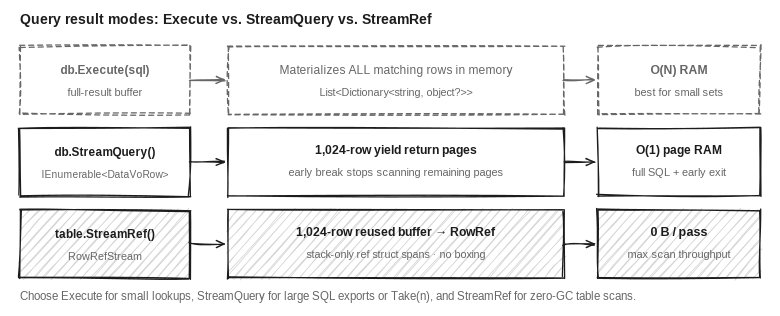
| API | Element Type | Memory & Allocation | Best For |
|---|---|---|---|
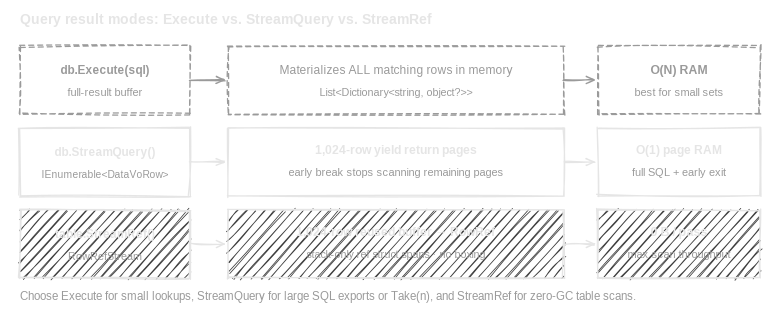
db.Execute(sql) | List<Dictionary<string, object?>> | Buffers full result set | Small results, DDL/DML, scripts |
db.StreamQuery(sql, ...) | IEnumerable<DataVoRow> | 1,024-row pages (yield return); owns cell array per row | Large SQL scans, .Take(n), early break |
db.Table<T>().Where(...) | IEnumerable<T> | 1,024-row pages (yield return); one POCO per row | Native AOT compiled domain queries without .ToList() |
db.StreamRef("T") / table.StreamRef() | RowRef (readonly ref struct) | 0 B per row after warmup | 60/120 FPS simulation loops and GC-free aggregators |
Paged SQL Streaming (db.StreamQuery)
For eligible single-table SELECT queries, StreamQuery fetches 1,024-row pages lazily and yields each DataVoRow:
- Early exit &
LIMIT: WithLIMIT k [OFFSET n], each batch caps its fetch size toMath.Min(1024, remaining + skip)and exits viayield breakoncekrows are emitted. - Owned rows: Each
DataVoRowowns its decoded values (row["Column"]orrow[ordinal]), so you can safely store rows beyond the loop iteration. - Per-page locking: During pure paged streaming, DataVo acquires and releases the read scope per 1,024-row page, so a slow consumer never stalls concurrent writers.
StreamQuery automatically falls back to materializing first (while still streaming the resulting rows lazily) when a query uses JOIN, GROUP BY, HAVING, ORDER BY, DISTINCT, CTEs, RANK(), indexed equality probes, or runs inside an explicit BEGIN transaction (which needs a single snapshot).
Compiled DataVoTable<T> Streaming
Enumerating a source-generated [DataVoTable] query without calling .ToList() streams 1,024-row pages of strongly-typed entities:
foreach (Player p in db.Table<Player>().Where(100, static (p, min) => p.Score >= min))
{
    ProcessPlayer(p);
}

foreach (Player nearby in db.Table<Player>().WithinRadius(origin, radius: 25f))
{
    RenderNearby(nearby);
}
Only call .ToList() when you intentionally need every matching object buffered at once.
Zero-Allocation Scans (StreamRef)
DataVo Extension
StreamRef (RowRefStream yielding stack-only RowRef spans) is a DataVo .NET-native extension designed for zero-GC hot loops.
When allocating even one DataVoRow or POCO per row is too expensive, stream raw page views with StreamRef:
RowRefStream stream = db.Table<Player>().StreamRef();
int scoreCol = stream.GetOrdinal("Score");

long total = 0;
foreach (RowRef row in stream)
{
    if (!row.IsNull(scoreCol))
        total += row.GetInt32(scoreCol);
}
RowRef is a readonly ref struct backed by a reusable page buffer, allocating 0 bytes on the managed heap after warmup. Because the buffer is overwritten on the next page, RowRef cannot be stored past its loop iteration or captured across await.
API Reference
// DataVoContext
public IEnumerable<DataVoRow> StreamQuery(string query, params DataVoQueryParameter[] parameters);
public IEnumerable<DataVoRow> StreamQuery(string query, Guid sessionId);
public RowRefStream StreamRef(string tableName);

// DataVoTable<T>
public RowRefStream StreamRef();
See Also
- Zero-Allocation Row Model: Memory layout and typed accessors of
RowRef - Live Reactive Views: Receive incremental deltas instead of rescanning tables
- Roslyn Source Generators: Compile-time predicates on
DataVoTable<T>