

Packed byte buffers, Native AOT, and Roslyn codegen: how a 55 ns point lookup works with zero native binaries
Part 2 of 7.
In Part 1, one benchmark line stood out above the rest: looking up a single row by primary key out of 100,000 shuffled records took 55.0 ns in memory and 216.2 ns on LSM disk files on an Apple M4 Pro (7.7–13× faster than SQLite), allocating 56 B in memory (the size of the returned Player object itself) and 144 B on disk, versus 608 B for Microsoft.Data.Sqlite.
Why does a C# implementation finish an in-memory lookup roughly an order of magnitude faster than SQLite, a C library?
The difference is boundary and abstraction cost, not instruction throughput. Calling into a C library from .NET crosses a P/Invoke boundary and steps through a dynamically typed C API on every row. When the storage engine lives in the same managed compilation unit as the caller, and the C# compiler knows the table layout and query predicate at build time, those layers are replaced by inlined bounds checks, aligned loads, and a single object allocation.
At a glance, five engineering choices drive both the speed and the packaging story:
- Zero native binaries and zero interop marshalling: Keeping the entire engine in pure .NET 10 removes per-OS native libraries and lets the JIT and AOT compilers inline straight from your query call into storage buffers.
- Cache-aligned packed byte buffers: Fixed-width columns sit contiguously inside 64-byte aligned Pinned Object Heap buffers rather than per-row objects, shrinking retained memory 13× from 640.3 B/row to 49.2 B/row (with shared strings).
- Lock-free optimistic reads: In-memory primary-key lookups take no lock, pairing opposite volatile write/read ordering so a concurrent delete can never surface a half-read row.
- Immutable prepared-statement templates: Parsing SQL once and cloning parameter-bound syntax trees lets concurrent threads, LSM point lookups, and live reactive views share one prepared query safely.
- Compile-time Roslyn code generation under Native AOT: Incremental source generators replace runtime reflection and expression-tree compilation with static readers and build-time interceptors, passing
PublishAot=truewith 0 trim/AOT warnings.
Each of these optimizations trades runtime cost for additional parity invariants against the general SQL evaluator, memory-ordering constraints, or compiler requirements; the final section examines those trade-offs.
The invisible tax of crossing the managed–native boundary
When a .NET application reads one row from an in-memory SQLite database via a prepared SqliteCommand, the lookup is far more than a B-tree probe in RAM. Even after Prepare() compiles the SQL into VDBE bytecode, every row fetch crosses an ABI boundary and navigates a dynamically typed C API 2 3 (Figure 1).
- Managed command and parameter overhead. Setting
_sqliteId.Value = idboxes the integer intoobject?, andExecuteReader()allocates aSqliteDataReaderand steps throughMicrosoft.Data.Sqlite's state machine. - Crossing the P/Invoke boundary. Each call into
e_sqlite3(sqlite3_reset,sqlite3_bind_int64,sqlite3_step, and onesqlite3_column_*call per column) crosses an unmanaged calling convention. The .NET JIT cannot inline acrossDllImportor eliminate redundant checks, so it pays a fixed transition tax on every invocation. - Dynamic column typing and string transcoding. SQLite uses dynamic type affinity per cell 2. Reading
Namecallssqlite3_column_text, inspects a null-terminated UTF-8 pointer in unmanaged memory, and transcodes it into a newly allocated UTF-16.NETstringon every lookup, even in:memory:. - Optional ORM mapping overhead. Mapping rows through Dapper adds dynamic reader-to-POCO reflection on top of ADO.NET (DataVo supports Dapper via
DataVoConnectionas documented in Dapper, though the BenchmarkDotNet suite below tests raw ADO.NET readers rather than Dapper). Under Native AOT, reflection-heavy mapping also conflicts with IL trimming.
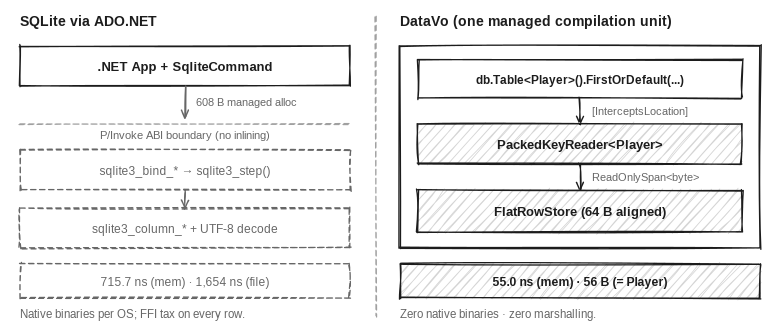
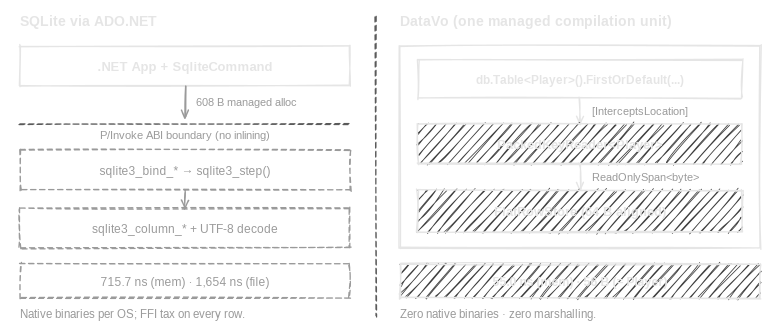
Figure 1: SQLite managed-to-native P/Invoke boundary versus DataVo's single managed compilation unit.
Keeping the engine in managed C# eliminates that entire boundary. On net10.0, DataVo.Core.csproj has only one NuGet package reference (System.Numerics.Tensors 10.0.0, which compiles to managed SIMD intrinsics), and DataVo.Data.csproj references only DataVo.Core, leaving zero .dll, .so, or .dylib files per target platform and zero UTF-8-to-UTF-16 transcoding for in-memory strings.
Yet removing the FFI wall alone is not enough: an earlier pure-managed build of DataVo still took 405–566 ns and allocated 1,008 B per in-memory lookup (slower than its own LSM disk engine at 241 ns) because every row still lived as a scattered heap object.
Packing rows into cache-aligned byte buffers (FlatRowStore)
In a straightforward managed in-memory store, each row is an object holding a CellValue[] or dictionary. On our six-column Player benchmark model, that object-per-row layout retained 640.3 bytes per row (with shared strings), forcing the CPU to chase scattered pointers and handing the garbage collector hundreds of thousands of heap references to scan during Gen-2 collections 1.
[DataVoTable("players")]
public sealed class Player
{
    [PrimaryKey] public int Id { get; set; }
    public bool Active { get; set; }
    [Columnar] public int Level { get; set; }
    [Columnar] public long Gold { get; set; }
    [Columnar] public double Ratio { get; set; }
    public string Name { get; set; } = "";
}
To replace per-row objects without risking manual Marshal.AllocHGlobal memory management, DataVo's in-memory storage packs rows into FlatRowStore (DataVo.Core/StorageEngine/Memory/FlatRowStore.cs), splitting each table into two parallel 4,096-slot chunk structures indexed by an immutable, append-only row number.
64-byte aligned Pinned Object Heap chunks
Fixed-width columns live inside FlatSlotList → FlatChunk (DataVo.Core/Memory/Flat/FlatChunk.cs). Each chunk allocates 4,096 slots (1 << 12; tiny tables start at FirstChunkRows = 16) directly on the .NET 10 Pinned Object Heap (POH) 3 and offsets slot 0 to a 64-byte cache-line boundary:
// DataVo.Core/Memory/Flat/FlatChunk.cs
_memory = GC.AllocateArray<byte>(length + Alignment - 1, pinned: true);
_start = AlignmentGap(_memory); // Alignment = 64
Because the GC owns the chunk and never moves or frees it while referenced, a lock-free reader holding a ReadOnlySpan<byte> can never touch dangling memory. Variable-length managed references (strings and float[] vectors) cannot sit inside raw byte arrays without hiding pointers from the GC, so ReferenceDirectory stores them in parallel object?[] chunks indexed by the same slot number (slot & 4095).
Widest-first alignment and the 32-byte Player record
Inside each slot, RowLayout.Create (DataVo.Core/StorageEngine/Memory/RowLayout.cs) packs fixed-width columns widest first—16-byte (Decimal, Guid), 8-byte (Int64, Double), 4-byte (Int32, Date), then 1-byte (Boolean)—followed by a 1-byte status flag, a null bitmask ((cols + 7) >> 3 bytes), and 8-byte alignment padding. Every primitive sits on a multiple of its own width with zero interior padding holes, compressing Player into 32 bytes plus one reference slot for Name (Figure 2):
Gold(Int64, 8 B): bytes0..7·Ratio(Double, 8 B): bytes8..15Id(Int32, 4 B): bytes16..19·Level(Int32, 4 B): bytes20..23Active(Boolean, 1 B): byte24·Status: byte25(0 = Empty,1 = Packed,2 = KeptApart)NullBits: byte26· Padding: bytes27..31→RecordBytes = 32
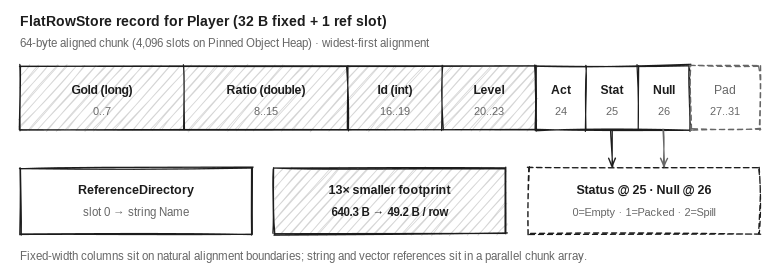
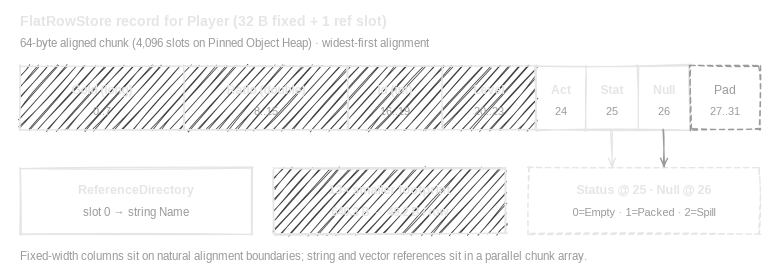
Figure 2: FlatRowStore 32-byte widest-first packed record layout for Player and its parallel ReferenceDirectory.
Switching to FlatRowStore cut retained row-store memory 13×: from 640.3 B/row down to 49.2 B/row with shared strings (145.3 B/row with unique "player-N" strings; 231.6 B/row including the primary-key index). If dynamic SQL inserts a mismatched cell type (such as a BIGINT into an INT column), FlatRowStore.Add spills only that row into a side ConcurrentDictionary<int, CellValue[]> marked StatusKeptApart = 2 so ordinary rows pay zero overhead.
For streaming scans over serialized rows (including LSM SSTables), DataVo applies the same principle via RowRef (DataVo.Core/Streaming/RowRef.cs), a stack-only readonly ref struct wrapping ReadOnlySpan<byte> that decodes cells on demand without heap allocations (see Zero-Allocation Row Model).
Tracing a 55 ns point lookup and the 216 ns LSM fallback
Here is the BenchmarkDotNet lookup in PointLookupBenchmarks.cs:
// Intercepted at build time via [InterceptsLocation]:
Player? found = _players.FirstOrDefault(id, static (p, key) => p.Id == key);
At build time, DataVo.Generators intercepts that call site and routes it to a generated DataVoLinqPlan<Player, int> that extracts the integer primary key directly without building SQL or boxing parameters. At runtime, execution splits cleanly between the in-memory shortcut and the LSM disk path (Figure 3).
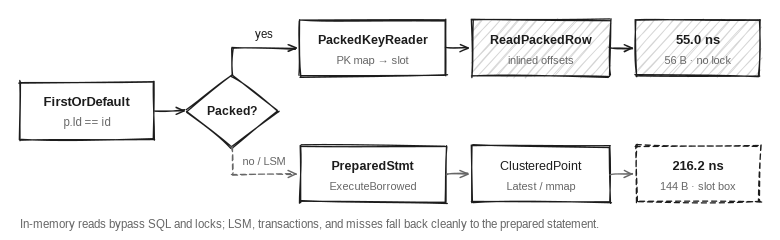
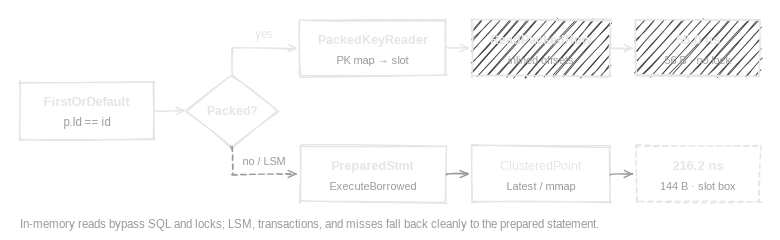
Figure 3: The 55 ns lock-free PackedKeyReader<T> shortcut versus the 216 ns LSM ClusteredPoint path.
Path A: In-memory PackedKeyReader<T> (55.0 ns, 56 B)
When DataVoLinqPlan.FirstOrDefault calls table.TryReadByIntegerKey(key, out item), PackedKeyReader<T> (DataVo.Core/Tables/PackedKeyReader.cs) first checks a fail-closed guard (MustUseStatement()): it steps aside if storage is not packed, authorization or diagnostics are enabled, or the session is inside an explicit transaction, MVCC snapshot, or active row write lock.
Otherwise, it reads without taking any lock:
- Probes the cached concurrent primary-key map (
ConcurrentInt64Int64Map) forkey → rowId. - Borrows a
FlatRowspan atposition = (int)(rowId - 1)viarows.TryReadPacked(...)and verifiesbinding.KeyOf(row.Record) == key. - Wraps the span in a stack-only
DataVoPackedRowref structand calls the generatedReadPackedRowdelegate to populatenew Player { ... }directly from fixed byte offsets. - Verifies
rows.IsTypedLive(position)after constructingPlayerso a concurrent delete can never return a torn or half-cleared row.
Details: lock-free ARM64 liveness proof & 56-byte allocation math
A packed row in FlatRowStore is immutable once published: its fixed-width bytes are never rewritten in place. The only concurrent mutation is FlatRowStore.Remove(index), which writes the empty status byte before clearing managed references:
// Writer: DataVo.Core/StorageEngine/Memory/FlatRowStore.cs + RowLayout.cs
Layout.MarkEmpty(record);                   // 1. Volatile.Write(ref record[StatusOffset], 0)
FlatRowCodec.ClearReferences(Layout, ...);  // 2. Volatile.Write(ref references[base + slot], null)
PackedKeyReader<T>.TryReadFrom reads in the exact opposite volatile order 4:
// Reader: DataVo.Core/Tables/PackedKeyReader.cs
try
{
    // 1. Fixed-width bytes (immutable) + reference slots via Volatile.Read
    item = _read(new DataVoPackedRow(row, binding.Fields!));
}
catch (Exception) when (!rows.IsTypedLive(position))
{
    // Row was removed mid-read, so a cleared non-null string threw NullColumn.
    return false;
}

// 2. Trailing acquire load on StatusOffset: Volatile.Read(ref record[StatusOffset]) != 0
return rows.IsTypedLive(position) && source.Table.CurrentRows is not null;
Because the writer issues a release store on Status = Empty before clearing references, and the reader issues acquire loads on every reference before checking IsTypedLive, any reader that sees a cleared reference is guaranteed to also see Status = Empty, even on weakly ordered ARM64 cores like the Apple M4 Pro. If a delete raced with the lookup, the partial object is discarded and the call falls back cleanly to the prepared statement.
The 56 bytes of managed heap allocation on 64-bit .NET are the exact size of the Player instance itself: 16 B object/MethodTable header + 8 B Gold + 8 B Ratio + 8 B Name reference + 4 B Id + 4 B Level + 1 B Active + 7 B alignment padding = 56 B (0 B engine overhead).
Path B: LSM file ClusteredPoint (216.2 ns, 144 B)
Under StorageMode.Lsm, PackedKeyReader<T> declines (!_packedStorage), so DataVoLinqPlan executes the slot's cached DataVoPreparedStatement via ExecuteBorrowed(p0). Because Player has a single INT primary key, LSM stores rows clustered directly under that key, so SelectAccessKind.ClusteredPoint (DataVoPreparedStatement.Plans.cs) skips any secondary index hop and calls LsmStorageEngine.TryVisitStoredRowByKey.
LsmStorageEngine probes the lock-free LatestRows write overlay first, then acquires an immutable TableVersion to search memory-mapped SSTable V2 files (SsTableV2Reader.Lookup) into a thread-local _singleRowScratch buffer. VisitClusteredPointRow decodes only the projected columns into a reusable thread-local RowResultSlot (avoiding fresh primitive boxes), and ReadRow constructs Player (56 B) plus the decoded UTF-8 Name string (~48–56 B), totaling 144 B and 216.2 ns.
Details: reusing boxed primitives in RowResultSlot
When returning rows through ExecuteBorrowed, RowResultSlot (DataVo.Core/PreparedStatements/DataVoPreparedStatement.Plans.cs) avoids allocating fresh boxed int, long, float, double, and Guid objects on every lookup by reusing pre-allocated per-slot boxes in place (using BoxedIntegerCache for -1..32767 and Unsafe.Unbox<T> for everything else):
// DataVo.Core/PreparedStatements/DataVoPreparedStatement.Plans.cs
[MethodImpl(MethodImplOptions.AggressiveInlining)]
public object BoxInt64(int ordinal, long value)
{
    object box = _boxedLongs[ordinal];
    Unsafe.Unbox<long>(box) = value;
    return box;
}
This is safe only because ExecuteBorrowed callers, such as generated ReadRow delegates, unbox every cell immediately before the next query executes on the same thread.
Cross-platform BenchmarkDotNet results
Figure 4 and the table below summarize PointLookupBenchmarks across Apple M4 Pro (02fa240f), Linux x64 CI, and Windows x64 CI (run 44748508039).
Test environments (Apple M4 Pro, Linux x64 CI, Windows x64 CI)
| Environment | Hardware | Runtime | Source |
|---|---|---|---|
| Apple M4 Pro | 12 cores, 48 GiB, APFS SSD | .NET 10.0.3, Arm64 RyuJIT, macOS 26.3 | BDN 0.15.8 (--job short, 02fa240f, 20 Nov 2026) under docs/public/benchmarks/2026-11-21-m4pro/ |
| Linux x64 CI | AMD EPYC 9V45, 4 logical / 2 physical cores | .NET 10.0.15, Ubuntu 26.04 | GitHub Actions run 44748508039 (master @ 02fa240f, 20 Nov 2026) |
| Windows x64 CI | Xeon Platinum 8370C, 4 logical / 2 physical cores (Hyper-V) | .NET 10.0.15, Windows 11 24H2 | GitHub Actions run 44748508039 (master @ 02fa240f, 20 Nov 2026) |
| Primary-key lookup (100k rows, shuffled) | DataVo (Mem) | DataVo (LSM File) | SQLite (Mem) | SQLite (WAL File) | DuckDB 1t (File) |
|---|---|---|---|---|---|
Apple M4 Pro (02fa240f) | 55.01 ns (±5.61 ns) | 216.22 ns (±12.90 ns) | 715.65 ns | 1,654.00 ns | 62,702 ns |
Linux x64 CI (44748508039) | 130.8 ns | 288.3 ns | 1,398.2 ns | 3,642.7 ns | 204,140 ns |
Windows x64 CI (44748508039) | 239.6 ns | 666.9 ns | 2,024.0 ns | 6,741.1 ns | 380,684 ns |
| Managed alloc / call (64-bit .NET 10) | 56 B | 144 B | 608 B | 608 B | 2,144 B |
(On the full-job 13 November M4 Pro run ce818d4, DataVo in-memory measured 52.1 ns mean / 49.3 ns median, ±2.3 ns error.)

Figure 4: Primary-key point lookup latency across Apple M4 Pro, Linux x64 CI, and Windows x64 CI (Panel A), and managed heap allocation per operation for point lookups and filtered COUNT(*) (Panel B).
Scope note: this benchmark compares DataVo's build-time compiled LINQ path against SQLite and DuckDB over ADO.NET. When all engines run raw SQL text prepared statements (sql-workload over 1,000,000 file-backed rows on the M4 Pro; see Benchmark Results), DataVo takes 1.4 µs (INT key) and 1.2 µs (GUID key) versus SQLite's 2.0 µs and 2.2 µs (1.4–1.8× faster), because raw SQL callers pay for owned QueryResult dictionaries rather than ExecuteBorrowed.
Prepared statements, AST isolation, and the bridge to reactive views
Underneath both raw SQL and generated LINQ sits DataVoPreparedStatement (DataVo.Core/PreparedStatements/DataVoPreparedStatement.cs). Calling ctx.Prepare(sql) runs Lexer and Parser once, stores the template List<SqlStatement>, and runs InitializeFastPathCandidates() to classify eligible single-table SELECT, UPDATE, and DELETE shapes. On first execution it caches a schema-versioned CompiledSelectPlan that automatically invalidates on ALTER TABLE.
Why template ASTs are never mutated
Mutating parameter placeholder nodes in place during binding breaks concurrency as soon as two threads or two standing views share one prepared statement. DataVo prevents that structurally via SqlParameterBinder (DataVo.Core/PreparedStatements/SqlParameterBinder.cs): whenever execution falls back to the general evaluator or seeds a reactive view, BindStatement clones the template AST and replaces every ParameterNode (across WHERE, SELECT, CTEs, HAVING, and LIMIT/OFFSET) with immutable BoundValueLiteralNode or NullLiteralNode values, keeping the shared template strictly read-only (Figure 5).
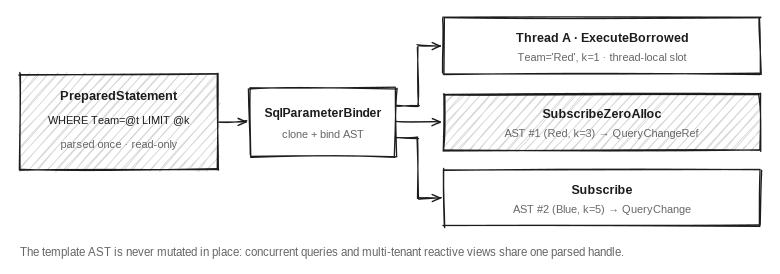
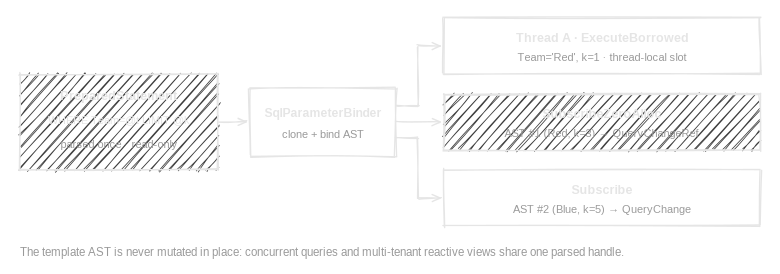
Figure 5: Prepared statement AST isolation via SqlParameterBinder serving concurrent executions and independent reactive views from one parsed handle.
Owned vs. borrowed execution and zero-reparse reactive subscriptions
DataVoPreparedStatement provides Execute(...) (returning an owned QueryResult) alongside ExecuteBorrowed(...), which returns the thread-local RowResultSlot.HitResult and uses 1-to-4 parameter stack-struct overloads (TwoParams, ThreeParams, FourParams) to avoid params[] array allocations. That same AST-isolation pipeline feeds DataVo's Z-set incremental view engine 7 through BindSingleReactiveStatement:
// Parse once, bind independently for multiple live views:
DataVoPreparedStatement teamTop = ctx.Prepare(
    "SELECT Id, Name, Score FROM Player WHERE Team = @team ORDER BY Score DESC LIMIT @k");

using var redTop3 = ctx.SubscribeZeroAlloc(
    teamTop,
    (in QueryChangeRef change) => ApplyHudDelta(change.Added, change.Updated, change.Removed),
    ("team", "Red"), ("k", 3));

using var blueTop5 = ctx.Subscribe(
    teamTop,
    change => LogTeamChanges(change),
    ("team", "Blue"), ("k", 5));
Before attaching any capture hook, BindSingleReactiveStatement validates that the template holds a single SELECT, rejects unsupported constructs like DISTINCT aggregates, clones an isolated AST bound to each subscription's parameters, and passes it straight to ReactiveRegistry with zero SQL re-parsing (see Live Reactive Views (Z-set IVM)).
Replacing runtime reflection and Expression.Compile() with Roslyn codegen
Traditional .NET LINQ providers turn lambdas into heap-allocated Expression<Func<T, bool>> trees, walk them at runtime, and compile mappers via Expression.Compile() or Reflection.Emit. Under Native AOT, Reflection.Emit is unavailable, Expression.Compile() drops to a slow interpreter, and reflection over arbitrary model properties fights the IL trimmer 6.
DataVo.Generators flips that pipeline: it uses ordinary Func<...> lambdas, zero Expression trees, and two Roslyn IIncrementalGenerators 5 to move schema discovery, SQL generation, predicate compilation, and row materialization entirely to csc build time (Figure 6).
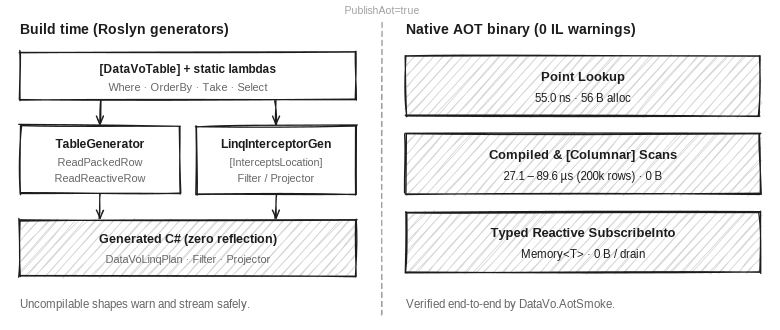
Figure 6: What moves to build time in DataVo.Generators versus what ships inside the trimmed Native AOT binary.
DataVoTableGenerator: four readers, zero reflection
Marking a model [DataVoTable("players")] triggers DataVoTableGenerator via ForAttributeWithMetadataName to emit PlayerDataVoExtensions, registering DataVoTableInfo<Player> automatically through [ModuleInitializer]. Instead of reflecting over properties at startup, it generates four specialized readers—ReadRow, ReadStreamedRow, ReadPackedRow, and ReadReactiveRow—with column ordinals baked into IL as compile-time constants:
// Simplified excerpt of what DataVoTableGenerator emits for Player:
private static readonly DataVoPackedReader<Player> ReadPackedRow = static row =>
    new Player()
    {
        Id     = row.ReadInt32(0, "Id"),
        Active = row.ReadBoolean(1, "Active"),
        Level  = row.ReadInt32(2, "Level"),
        Gold   = row.ReadInt64(3, "Gold"),
        Ratio  = row.ReadDouble(4, "Ratio"),
        Name   = row.ReadString(5, "Name"),
    };

private static Player ReadReactiveRow(in DataVo.Core.Runtime.Reactive.RowRef row)
{
    return new Player()
    {
        Id     = row.ReadInt32(0, "Id"),
        Active = row.ReadBoolean(1, "Active"),
        Level  = row.ReadInt32(2, "Level"),
        Gold   = row.ReadInt64(3, "Gold"),
        Ratio  = row.ReadDouble(4, "Ratio"),
        Name   = row.ReadString(5, "Name"),
    };
}DataVoLinqInterceptorGenerator: [InterceptsLocation] at every call site
For LINQ-shaped calls on DataVoTable<T> (FirstOrDefault, SingleOrDefault, Where, OrderBy/ThenBy, Select, Sum, Min, Max, ExecuteUpdate), DataVoLinqInterceptorGenerator emits C# 12+ [InterceptsLocation] interceptors 5 targeting each exact call site. For _players.FirstOrDefault(id, static (p, key) => p.Id == key), Roslyn rewrites the call to invoke the generated plan directly:
// Simplified excerpt of what DataVoLinqInterceptorGenerator emits:
private sealed class Plan0 : DataVoLinqPlan<Player, int>
{
    public static readonly Plan0 Instance = new Plan0();
    private Plan0() : base("Id = @p0", unique: true) { }

    // Enables PackedKeyReader<Player> to skip the prepared statement completely:
    protected override bool TryGetIntegerKey(int state, out long key)
    {
        key = (long)state;
        return true;
    }

    // Fallback path (LSM file, explicit transaction, miss):
    protected override QueryResult Run(DataVoPreparedStatement statement, int state, bool borrowed)
    {
        DataVoQueryParameter p0 = new DataVoQueryParameter("p0", state);
        return borrowed ? statement.ExecuteBorrowed(p0) : statement.Execute(p0);
    }
}

[InterceptsLocation(version: 1, data: "...")]
public static Player? FirstOrDefault0(
    this DataVoTable<Player> table, int state, Func<Player, int, bool> predicate)
{
    return Plan0.Instance.FirstOrDefault(table, state, predicate);
}
Beyond point lookups, the same generator powers two other zero-allocation paths:
- Compiled scan kernels (
IRowRefFilter/IColumnarFilter). For predicates over fixed-width columns (Where(50, static (p, min) => p.Level >= min).Count()),DataVoLinqEmitteremits a value-typestruct Kernel. Generic specialization across the storage loop eliminates delegate calls and row allocations, running[Columnar]Count,Sum,Min, andMaxover 200,000 rows in 27.1–89.6 µs with 0 B heap allocation versus 504 B for SQLite and 1,136–1,169 B for DuckDB (Figure 4, Panel B; see Compiled Scan Kernels). - Zero-allocation reactive HUD buffers (
SubscribeInto). When a composed query ends in.Select(...),DataVoLinqShapeEmitteremits a value-typeIReactiveRowProjector<TProjection>struct readingRowRefcells by constant ordinal intoBufferedWindowReactiveQuery, updating a caller-ownedMemory<HudSlot>slice onDispatchPendingNotifications()with 0 bytes allocated in steady state:
public readonly record struct HudSlot(int Id, int Score);

var hud = new HudSlot[3];
using var sub = db.Table<Player>()
    .Where(100, static (p, min) => p.Score >= min)
    .OrderByDescending(static p => p.Score)
    .Take(3)
    .Select(static p => new HudSlot(p.Id, p.Score))
    .SubscribeInto(hud.AsMemory(), count => RenderHud(hud.AsSpan(0, count)));
Transparent fallbacks when a lambda cannot compile
Any filter, sort key, or projection that the generator cannot translate still executes and returns exact results by streaming pages, while emitting a build diagnostic explaining why. Outside [InterceptsLocation], emitted code stays within C# 9 so older compilers (such as Unity's) compile [DataVoTable] models cleanly and keep Get<Model>ById and prepared statements fast (see Roslyn Source Generators).
Compiler fallback diagnostics (DATAVOL001–DATAVOL005)
| Diagnostic | Severity | Meaning |
|---|---|---|
DATAVOL001 | Warning | Lambda captures a local variable or instance member; pass it as state with a static lambda. |
DATAVOL002 | Warning | Predicate uses an untranslatable construct (arbitrary method call, arithmetic, column-to-column comparison, or mismatched type). |
DATAVOL003 | Warning | Project has not enabled <InterceptorsNamespaces>$(InterceptorsNamespaces);DataVo.Generated</InterceptorsNamespaces>. |
DATAVOL004 | Warning | OrderBy key or Select selector runs in memory over whole models. |
DATAVOL005 | Error | ExecuteUpdate cannot be compiled (it has no in-memory fallback, so failing at build time prevents a runtime NotSupportedException). |
Locking the Native AOT fence (184 warnings to zero)
Maintaining Native AOT compatibility across ongoing changes requires automated enforcement. A single unannotated JsonSerializer.Serialize, Activator.CreateInstance, or dynamic call site can break trimming 6.
When we first enabled <IsAotCompatible>true</IsAotCompatible> on DataVo.Core, the Roslyn trim and AOT analyzers reported 184 diagnostics. Rather than hiding them behind [UnconditionalSuppressMessage], we ratcheted the baseline down to zero across five passes (recorded in scripts/check-aot-baseline.sh):
| Milestone | Remaining IL Warnings | What was eliminated |
|---|---|---|
| Baseline fence | 184 | Initial enablement of .NET trim & AOT analyzers across DataVo.Core |
| T1: Catalog persistence | 144 | Removed XmlSerializer from schema catalog serialization |
| T2: Core JSON serialization | 100 | Replaced Newtonsoft.Json / reflection JSON with System.Text.Json source generation |
| T3: Execution & planner JSON | 76 | Migrated remaining Volcano / Select serialization paths to source-generated STJ |
| T4 + T5: Dynamic dispatch & factories | 0 | Eliminated all dynamic/DLR call sites and reflection Activator factories |
Once the count hit zero, we locked both DataVo.Core.csproj and DataVo.Data.csproj by promoting every trim and AOT analyzer code (IL2026 through IL3056) to a build error:
<!-- DataVo.Core/DataVo.Core.csproj -->
<IsAotCompatible Condition="'$(TargetFramework)' == 'net10.0'">true</IsAotCompatible>
<WarningsAsErrors Condition="'$(TargetFramework)' == 'net10.0'">$(WarningsAsErrors);IL2026;IL2046;IL2055;IL2057;IL2070;IL2072;IL2075;IL2080;IL2087;IL2090;IL2091;IL2092;IL2093;IL3050;IL3051;IL3052;IL3053;IL3054;IL3055;IL3056</WarningsAsErrors>
Two CI gates enforce this fence on every commit: scripts/check-aot-baseline.sh rebuilds both locked libraries in Release, and DataVo.AotSmoke publishes a standalone native executable (<PublishAot>true</PublishAot>, <InvariantGlobalization>true</InvariantGlobalization>) that runs dynamic SQL, InsertTyped, SubscribeZeroAlloc, ADO.NET (DataVoConnection/DataVoDataReader), [DataVoTable] registration, intercepted LINQ (Where, OrderBy, Skip, Take, Select, ExecuteUpdate, ExecuteDelete), RowRefStream, HNSW Vector3 search, prepared-statement reactive views, and SubscribeInto inside a trimmed native binary. Only DataVo.EntityFrameworkCore sits outside this guarantee due to EF Core's own upstream AOT constraints (see Native AOT).
What this cost in complexity, and where it stops paying off
In Part 1, I promised that Part 2 would explain not only how a 55 ns lookup is built, but what it cost in complexity. Shaving 660 nanoseconds out of a lookup shifts work into invariants, concurrency subtleties, and surface constraints:
- Dual-path parity is an ongoing tax.
PackedKeyReader<T>,CompiledSelectPlan,IRowRefFilter, and the general SQL evaluator are four distinct execution paths over the same tables. Every shortcut must fail closed: if a transaction is open, a schema version changed, a row isStatusKeptApart, or aFLOATsum on LSM might reorder rounding, the fast path must decline cleanly so the general evaluator produces exact SQL semantics. Keeping those paths bit-for-bit identical is why Part 6's differential oracle became essential. - Lock-free ordering and borrowed lifetimes. Optimistic reads over
FlatRowStorerely on exactVolatile.Write/Volatile.Readpairing on weakly ordered CPUs. Likewise,RowResultSlot'sUnsafe.Unbox<T>box reuse inExecuteBorrowedis safe only because generated readers unbox immediately before returning. Exposing borrowed mutable boxes carelessly to callers would invite silent aliasing bugs. - Compile-time surface limits. Roslyn interceptors require C# 12+ and
staticlambdas with explicit state arguments. They compile single-table predicates, sorts, paging, projections, aggregates, and bulk updates—not joins,GROUP BY,DISTINCT, or arbitrary vector expressions, which remain SQL territory. Even onDataVoTable<T>, placing astringcolumn before fixed-width columns disables fixed-offset byte-scan kernels because variable-width text shifts subsequent cell offsets. - Amdahl's Law still rules disk durability. Cutting a lookup from
1,654 nsto216 nsmatters directly in a 60 FPS game loop, telemetry pipeline, or high-QPS read cache. It barely registers on a durable write waiting for an SSD flush: withLsmStrictFsync = trueon Apple's APFS SSD or WindowsFlushFileBuffers, both DataVo and SQLite hit the same ~4.0 ms floor (roughly 72,000× longer than a 55 ns lookup).
In practice, let your workload pick the interface (see Choosing an Interface): use [DataVoTable] + compiled LINQ for hot single-table lookups, aggregates, and HUD windows; use ctx.Prepare(...) for parameterized SQL, joins, and multi-tenant reactive views; and use DataVo.Data / Dapper when ADO.NET ecosystem compatibility matters more than shaving the last few hundred nanoseconds.
Source Code
FlatRowStore, PackedKeyReader<T>, DataVo.Generators, and DataVo.AotSmoke are available in ArintonAkos/DataVo-DBMS.
What comes next
- Part 3. What an fsync costs, across operating systems: the 4 ms tie, the 0.1 ms Linux case, and the Windows scaling problem.
- Part 4. Z-sets, from incremental views to a 36 MB sync: wire protocol, offline conflict convergence, and reproducible Docker benchmarks against PostgreSQL 17 and ElectricSQL 1.8.1.
- Part 5. HNSW, the JIT, and the exact fallback: recall on clustered data, and why a graph search sometimes loses to a scan.
- Part 6. Differential oracle testing: how the matrix found five wrong answers before tuning anything.
- Part 7. Building an offline-first .NET 10 app end-to-end: combining Native AOT, filtered
VECTOR(n)search, live Z-set views, and bidirectional Postgres sync in a real desktop/mobile architecture.
References
- Martin Kleppmann. Designing Data-Intensive Applications. Chapter 3: "Storage and Retrieval." O'Reilly Media, 2017.
- SQLite Documentation. "An Introduction To The SQLite C/C++ Interface" (
sqlite3_prepare_v2,sqlite3_bind_*,sqlite3_step,sqlite3_column_*) and "Datatypes In SQLite." sqlite.org/cintro.html. - Microsoft .NET Documentation. "Native interoperability best practices" and "Pinned Object Heap (
GC.AllocateArray)." learn.microsoft.com. - ECMA-335 Common Language Infrastructure & .NET Memory Model (
System.Threading.Volatile.Read/Volatile.Writeacquire-release semantics on weakly ordered ARM64 processors). - Roslyn / C# Language Design. "Interceptors" (
[InterceptsLocation]) and "Incremental Generators" (IIncrementalGenerator) specifications. github.com/dotnet/roslyn. - Microsoft .NET Documentation. "Native AOT deployment overview" and "Trimming and AOT warnings (
IL2026,IL3050)." learn.microsoft.com. - Mihai Budiu, Frank McSherry, Leonid Ryzhyk, Val Tannen. "DBSP: Automatic Incremental View Maintenance for Rich Query Languages." Proceedings of the VLDB Endowment 16(7), pp. 1601–1614, 2023.
Data sources
- Source code audited:
DataVo.Core/StorageEngine/Memory/{FlatRowStore,RowLayout,FlatRowCodec}.cs,DataVo.Core/Memory/Flat/{FlatChunk,FlatSlotList,ReferenceDirectory}.cs,DataVo.Core/Tables/{DataVoTable,DataVoLinqPlan,PackedKeyReader,DataVoPackedRow,DataVoReactiveLinq}.cs,DataVo.Core/PreparedStatements/{DataVoPreparedStatement,DataVoPreparedStatement.Plans,SqlParameterBinder}.cs,DataVo.Core/StorageEngine/Lsm/LsmStorageEngine.cs,DataVo.Core/Streaming/RowRef.cs,DataVo.Core/Runtime/Reactive/{IReactiveRowProjector,BufferedWindowReactiveQuery}.cs,DataVo.Generators/{DataVoTableGenerator,DataVoLinqInterceptorGenerator}.cs,DataVo.Generators/Tables/DataVoTableEmitter.cs,DataVo.Generators/Linq/{DataVoLinqEmitter,DataVoLinqShapeEmitter}.cs,DataVo.AotSmoke/{DataVo.AotSmoke.csproj,Program.cs,GeneratedTableSmoke.cs}, andscripts/check-aot-baseline.sh. - Benchmarks: Apple M4 Pro BenchmarkDotNet
0.15.8(02fa240f, 20 Nov 2026,--job short,docs/public/benchmarks/2026-11-21-m4pro/DataVo.Benchmarks.{PointLookup,FilteredAggregate}Benchmarks-report-github.md), earlier M4 Pro full-job point-lookup run (ce818d4, 13 Nov 2026,docs/manual/performance/benchmarks.md), and GitHub Actions Linux x64 & Windows x64 CI run44748508039(master@02fa240f, 20 Nov 2026). - Diagram & chart scripts:
docs/public/blog/part-2/make_diagrams.mjs(roughjs4.6.6) anddocs/public/blog/part-2/make_charts.py(matplotlib3.10.8).